



 |

With support from the Bill and Melinda Gates Foundation, the speaker's research group has developed, tested, and implemented coupled biochemical and electrochemical reactor systems that are designed for the onsite treatment of wastewater at its source. The treated wastewater is recycled as toilet flush water without discharge to the environment. Enteric organism disinfection is achieved for bacteria, protozoa, helminths, and viruses via reactive chlorine evolution (CER) due to the oxidation of chloride coupled with the cathodic reduction of water to form hydrogen (HER). With the use of proton exchange membranes, the generated hydrogen can be directly used in a hydrogen fuel cell to recharge Li-ion storage batteries. The fundamental aspects of semiconductor electrochemistry for the in situ production of reactive chlorine species, hydroxyl radical, ozone, and hydrogen peroxide will be presented. Alternative electrochemical reactor and anode materials will be introduced. Water treatment applications of electro-Fenton chemistry and electro-peroxone reactions to produce hydroxyl radical have also been implemented. Applications of the various electrochemical reactor configurations are being tested in advanced prototypes and commercial systems that are located in underserved areas of the world lacking modern urban infrastructure. Their Caltech/Eco-San onsite wastewater treatment systems can be operated without an external source of electricity or a source of fresh water. In the system shown below, the collected PV-power is stored in lithium ion battery packs in order to be able to operate the coupled biochemical and electrochemical reactor systems for 24 hours per day.
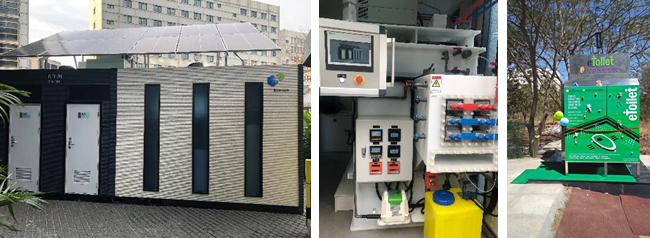
The Caltech/Eco-San (Yixing, China) PV-powered public toilet located in Beijing (left-hand panel) with a built-in coupled biological and electrochemical wastewater treatment system (middle-panel); the Caltech-ERAM public toilet and compact treatment system developed by Caltech/ERAM collaboration in India employs the same treatment scheme (right-hand panel). Wastewater is treated to near drinking water standards for recycling back for use as toilet flushing water.
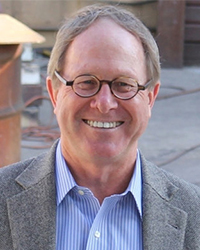
Prof. Michael R. Hoffmann received his BA in Chemistry from Northwestern University in 1968 and his PhD degree from Brown University in 1974. He was appointed as a Postdoctoral Fellow at the California Institute of Technology (Caltech) from 1973 to 1975. From 1975 to 1980, he served as an Assistant and Associate Professor at the University of Minnesota. He returned to Caltech in 1980 and joined the Environmental Science & Engineering faculty where he currently holds the title of John S. and Sherry Chen Professor of Environmental Science.
Prof. Hoffmann's research over 40 years has spanned the subject areas of atmospheric chemistry, chemical kinetics, catalytic oxidation and reduction, photochemistry, photocatalysis, nanotechnology, sonochemistry, photo-electrochemistry, pulsed-power plasma chemistry, environmental water chemistry, and microbiology. He has published more than 300 peer-reviewed professional papers and is the holder of 7 patents. According to Google Scholar, he has more than 61,100 citations with H-Index at 106. He has also been recognized by the Web of Science as one of the most highly cited researchers in engineering in the world.
Prof. Hoffmann was awarded the Humboldt Research Award by the Alexander von Humboldt Foundation in 1991, the Award for Creative Advances in Environmental Science and Technology by the American Chemical Society in 2001, the McKee Groundwater Protection, Restoration, or Sustainable Use Award by the Water Environment Federation in 2003 and the Alexander von Humboldt Foundation Senior Scientist Award in 2004. He also led his group to win the 2012 Bill and Melinda Gates Foundation's Reinvent The Toilet Challenge and the 2015 Vodafone Americas Foundation's Wireless Innovation Project. He is a Member of the US National Academy of Engineering and a Foreign Member of the Chinese Academy of Engineering.